
Ancient Egypt
The Great Gods · 12 words
Free printable puzzle · Large print
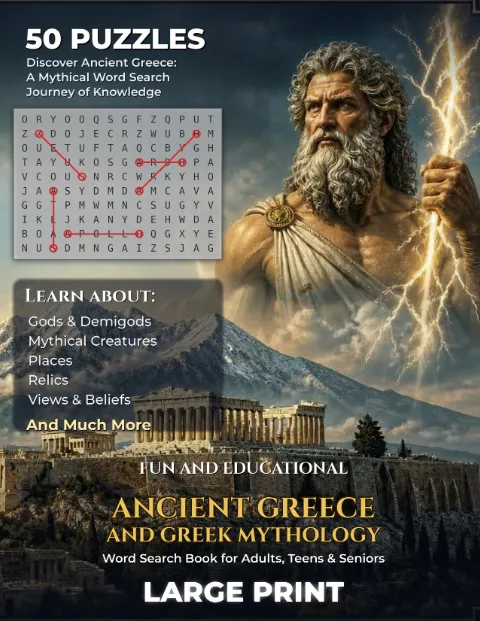
This is Puzzle 1 from our Ancient Greece & Greek Mythology word search book. Find the ten words hidden in the grid. Each time you find one, its background is revealed, exactly as it appears in the book.
Free Ancient Greece Word Search: Myths and Legends
From Ancient Greece & Greek Mythology Word Search · funcationbooks.com
Found 0 of 10 words
When you find a word, its background appears right here, exactly as it's explained in the book.
You found
From Ancient Greece & Greek Mythology Word Search
Drag across a word, or tap its first letter and then its last. Words run across, down or diagonally. Each word you find reveals its background from the book.
Well done! You found every word. There are 49 more puzzles like this in the book.
Get the full bookLearn as you solve
Every word you find unlocks its background here, taken straight from Ancient Greece & Greek Mythology Word Search. Find them all to read every story. In the book, all 50 puzzles come with explanations like these.
In Ancient Greece and Greek mythology, "Metamorphoses" refers to the transformative tales of gods, heroes, and mortals. These stories often involve magical or divine interventions that result in profound physical or spiritual changes. Ovid's epic poem "Metamorphoses" is a collection of these myths, showcasing the power of transformation and the interconnectedness of all beings.
Find this word in the puzzle to reveal its background.
Hercules, also known as Heracles, is one of the most celebrated heroes in Greek mythology. He possessed extraordinary strength and undertook twelve labors as punishment for killing his wife and children in a fit of madness. Hercules' tales exemplify courage, endurance, and the triumph of good over evil, making him an enduring symbol of heroism and determination in Ancient Greece.
Find this word in the puzzle to reveal its background.
In Ancient Greece, sorcery was the practice of using magic or supernatural powers to influence events or people. Sorcerers, also known as witches or magicians, were believed to possess knowledge and abilities beyond the natural world. The concept of sorcery often appears in Greek mythology, with characters like Circe and Medea renowned for their mastery of magical arts.
Find this word in the puzzle to reveal its background.
Ganymede was a mortal youth in Greek mythology who was so beautiful that Zeus, the king of gods, took a special interest in him. Zeus abducted Ganymede and made him the cupbearer of the gods on Mount Olympus, granting him immortality and eternal youth. Ganymede represents the ideal of beauty and divine favor, often depicted as a symbol of Zeus' affection and the embodiment of youthful splendor.
Find this word in the puzzle to reveal its background.
Persephone is a prominent figure in Greek mythology and the daughter of Zeus and Demeter, the goddess of harvest and fertility. She was abducted by Hades, the god of the underworld, and became his queen. Persephone's abduction and subsequent return from the underworld symbolize the changing seasons, with her time in the underworld representing winter and her return bringing the rebirth of spring.
Find this word in the puzzle to reveal its background.
"Legends and Lore" encompass the vast body of traditional stories and beliefs that formed the mythological fabric of Ancient Greece. These legends and folklore include tales of gods, heroes, monsters, and mythical creatures, providing insights into the cultural and religious beliefs of the ancient Greeks. Legends and lore were passed down through generations, serving as a source of entertainment, moral teachings, and explanations for natural phenomena.
Find this word in the puzzle to reveal its background.
The Fates, also known as the Moirai, were a trio of goddesses in Greek mythology who controlled the destiny and lifespan of every individual. Clotho spun the thread of life, Lachesis measured its length, and Atropos cut it, determining when a person's life would end. The Fates were seen as powerful and immutable forces, representing the concept of fate and the inevitability of mortality.
Find this word in the puzzle to reveal its background.
Nymphs were nature spirits in Greek mythology, associated with specific natural features such as forests, mountains, and bodies of water. They were depicted as beautiful, immortal maidens who possessed an intimate connection to the natural world. Nymphs played various roles in myths, often serving as companions or lovers of gods, heroes, or satyrs. They personified the untamed beauty of nature and were revered as symbols of fertility and abundance.
Find this word in the puzzle to reveal its background.
Temples held significant importance in Ancient Greece as sacred spaces dedicated to worshiping the gods. These grand structures, often adorned with ornate sculptures and intricate architectural designs, were the focal points of religious ceremonies, rituals, and sacrifices. Temples served as physical manifestations of the divine presence and were revered as places of spiritual connection and communion with the gods.
Find this word in the puzzle to reveal its background.
In Greek mythology, destiny, or fate (moira), referred to the predetermined course of events that were believed to be controlled by the gods or the Fates. It represented an unchangeable path that individuals were bound to follow, regardless of their actions or desires. The concept of destiny emphasized the idea of a cosmic order and the notion that human lives were guided by forces beyond their control. It also underscored the importance of accepting one's fate and the consequences of one's actions.
Find this word in the puzzle to reveal its background.
The Great Gods · 12 words
Life in the Roman World · 10 words
The City of Constantinople · 12 words
The Age of Exploration · 10 words