
History
12 Fascinating Facts About Ancient Egypt You Probably Didn't Know
Ancient Egypt lasted for more than three thousand years, from the unification of Upper and Lower Egypt around 3100 BCE to the death of Cleopatra in 30 BCE. Here are twelve facts that show just how remarkable, and surprisingly familiar, life along the Nile could be.
1. The Great Pyramid held a record for almost 3,800 years
The Great Pyramid of Giza, built for the pharaoh Khufu, was the tallest man-made structure on Earth for nearly 3,800 years. Its record wasn't broken until Lincoln Cathedral's spire rose in England around 1311 CE.
2. The pyramid builders were not slaves
It's one of history's most stubborn myths. Archaeological evidence suggests the pyramids were built by paid labourers, organised into teams with names like "Friends of Khufu". They received bread, beer and even medical care.
3. Egyptians called their country "the black land"
Egypt's name for itself was Kemet, the black land, after the rich dark silt the Nile left behind each year. The surrounding desert was deshret, the red land.
4. "Pharaoh" originally meant a building
The word comes from Egyptian per-aa, meaning "great house", which referred to the royal palace. Only late in Egyptian history did it come to mean the king himself.
5. Cats were sacred, and harming one was a serious crime
Egyptians kept cats, dogs, monkeys and even gazelles as pets. Cats were especially revered and linked to the goddess Bastet. Ancient writers report that killing one could carry the death penalty.
6. Cleopatra wasn't Egyptian by blood
Egypt's most famous queen belonged to the Ptolemaic dynasty, a Greek-speaking family descended from Ptolemy, one of Alexander the Great's generals. Cleopatra VII was said to be the first of her line to learn the Egyptian language.
7. They invented an early toothpaste
One Egyptian recipe combined rock salt, mint, dried iris flowers and pepper. It was probably more effective than pleasant.
8. Our calendar descends from theirs
The Egyptian civil calendar had 365 days: twelve months of 30 days plus five extra days at the end of the year. It's a direct ancestor of the calendar most of the world uses today.
9. Hieroglyphs were unreadable for over 1,400 years
After the last people who could read hieroglyphs died out, the script remained a mystery for more than fourteen centuries. Then the Rosetta Stone, carved with the same decree in three scripts, helped Jean-François Champollion crack the code in the 1820s.
10. Some gods were dark-skinned for a hopeful reason
Osiris, lord of the dead, and Anubis, guardian of embalming, were often painted black or green. These colours didn't stand for death. They stood for fertile soil and new life, a promise of rebirth.
11. Your heart was weighed against a feather
In the Hall of Judgement, a dead person's heart was weighed against the feather of Maat, goddess of truth and order. A heart heavy with wrongdoing was devoured by the monster Ammit. A balanced one won eternal life in the Field of Reeds.
12. A god created the world by speaking
In the tradition of Memphis, the craftsman god Ptah created the world by thinking of it in his heart and speaking its name aloud. It's one of the oldest known accounts of creation through the word.
Test yourself with a free Egypt word search
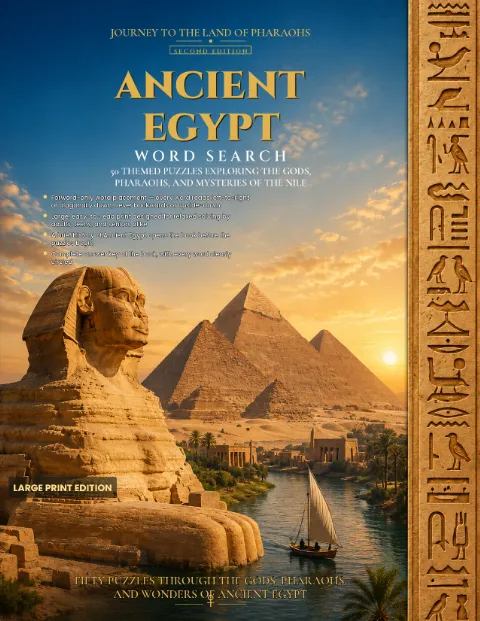
Can you find Ra, Osiris, Isis, Anubis and eight more of Egypt's great gods? Play our free Ancient Egypt word search online or print it out. It's Puzzle 1 from our large-print Ancient Egypt word search book, which has 50 themed puzzles and 600 words, every one explained.